
Article contents
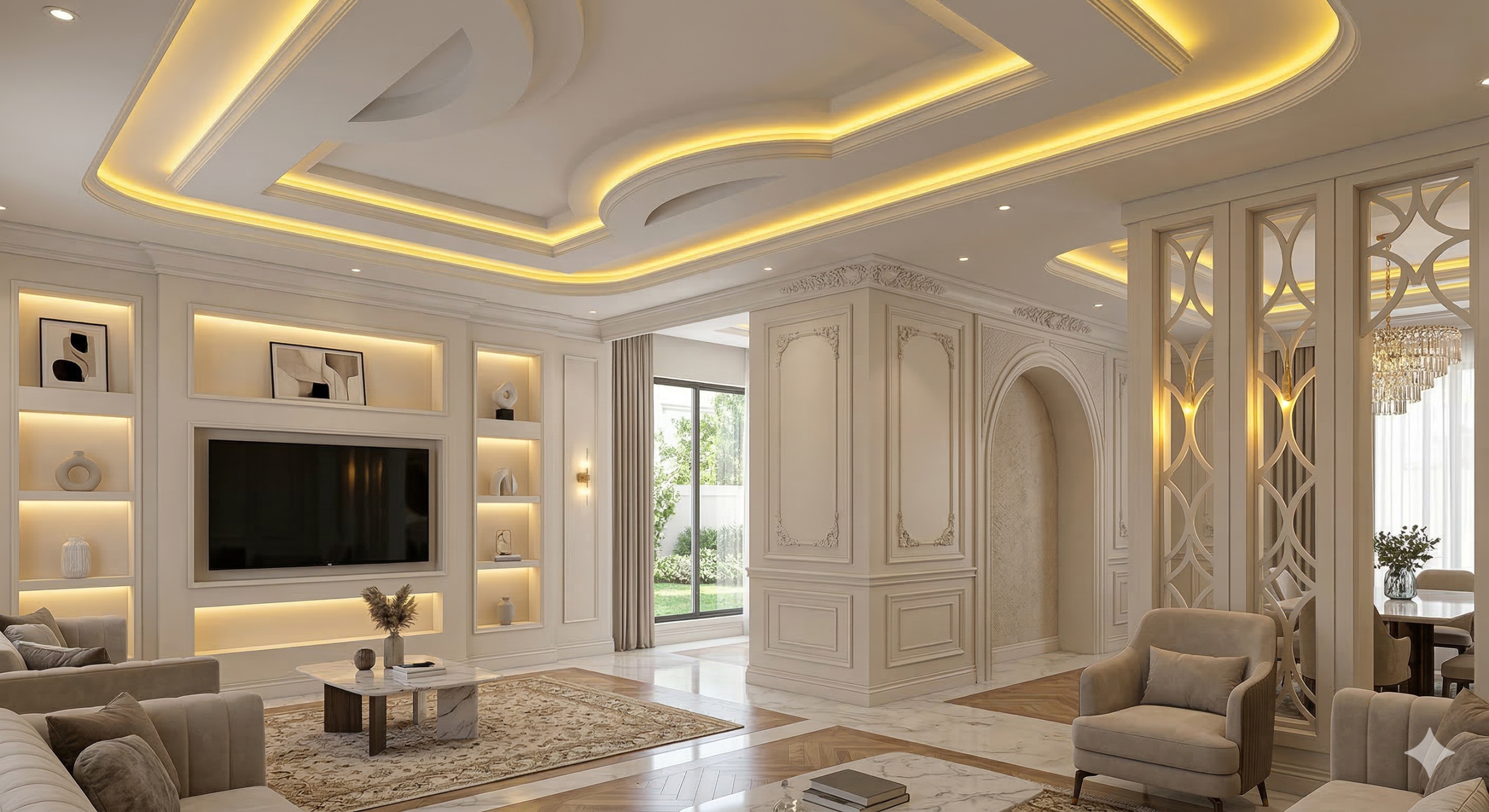
Gypsum board has become an essential part of finishing any modern Saudi home: multi-level ceilings with hidden lighting, lightweight partitions, TV feature walls and boxing in AC ducts. What many people don’t know is that gypsum board is not a single product. Using standard boards in a bathroom or kitchen, or where fire resistance is required, is a mistake that later shows up as stains, warping and sagging.
In this guide we explain the gypsum board types and where to use each one, the components of the complete system (not just the board), thicknesses, the most common installation mistakes and approximate prices.
What Is Gypsum Board?
A board made of a gypsum core covered with two layers of heavy paper. It is fixed to a metal frame of galvanized channels and angles, either suspended from the ceiling or fixed to the floor and walls; the joints are then treated with tape and compound, and it is painted.
The Main Gypsum Board Types
1. Standard Gypsum Board (White)
- Usual color: white or light gray paper.
- Use: ceilings and partitions in dry areas: bedrooms, living rooms, majlis rooms and corridors.
- Notes: the cheapest and most widely used, but it does not tolerate moisture.
2. Moisture-Resistant Gypsum Board (Green)
- Usual color: green paper.
- Use: bathrooms, kitchens, laundry rooms and high-humidity areas.
- Notes: its core and paper are treated to reduce water absorption, but it is moisture-resistant, not waterproof, so it must not be placed where water is sprayed on it.
3. Fire-Resistant Gypsum Board (Pink or Red)
- Usual color: pink or red paper.
- Use: commercial kitchens, electrical and generator rooms, corridors and stairwells in commercial buildings, and anywhere the authorities require fire resistance.
- Notes: its core contains added fibers that keep it intact longer in a fire.
4. Moisture- and Fire-Resistant Board
- Use: areas that need both, such as some commercial kitchens.
5. Acoustic Boards
- Use: meeting rooms, majlis rooms, home cinemas and hotels.
- Notes: denser, and usually combined with rock wool inside the partition for the best result.
6. Flexible (Thin) Gypsum Board
- Use: curved ceilings and walls, circles and arches.
7. Cement Board
Not gypsum, but often mentioned alongside it. Water-resistant cement boards used outdoors, for external ceilings under balconies and shades, and wherever the board will actually be exposed to water.
Summary Table: Which Type for Which Area?
| Area | Suitable type |
|---|---|
| Bedrooms, living rooms and majlis | Standard |
| Bathrooms | Moisture-resistant (green) with good ventilation |
| Home kitchens | Moisture-resistant |
| Commercial kitchens | Fire- and moisture-resistant |
| Electrical and generator rooms | Fire-resistant |
| Meeting rooms and cinemas | Acoustic with rock wool |
| External ceilings under shades | Cement board |
| Arches and curves | Flexible |
Common Thicknesses
| Thickness | Use |
|---|---|
| About 6.5 mm | Curves (flexible) |
| 9.5 mm | Some light ceilings |
| 12.5 mm | The most common for ceilings and partitions |
| 15 mm | Higher-performance and fire-rated partitions |
The Complete System: The Board Is Not Everything
Gypsum board quality depends on the whole system:
- Metal channels and angles: must be galvanized and of adequate gauge. Very thin steel makes the ceiling sag and ripple.
- Hanger spacing: the spacing between hangers and channels must follow the manufacturer’s recommendations; widening it to save material makes the ceiling drop.
- Screws: gypsum screws driven to the correct depth without tearing the paper.
- Tape and compound: treating the joints with tape and compound in layers is what prevents joint cracks later.
- Separation from walls: details that allow slight movement so the corners don’t crack.
The Most Common Gypsum Board Installation Mistakes
- Using standard board in a bathroom, which warps and stains within months.
- A thin steel frame or wide hanger spacing, which makes the ceiling wavy.
- Treating joints with compound only, without tape, so straight cracks appear along the joints.
- Hanging heavy chandeliers directly on the board without reinforcing the frame.
- Not leaving access panels for the AC and electrical systems.
- Installing gypsum before the concealed works are complete, then opening the ceiling to add a point.
- Closing a ceiling with a leak above it from a bathroom or roof, so stains appear later. Here the source must be fixed first; see our guide on treating wall dampness.
Gypsum Board or Moroccan Gypsum?
Gypsum board is for suspended ceilings, levels, hidden lighting and partitions, while Moroccan gypsum is a hand-carved decorative art. They are often combined in majlis rooms: a multi-level gypsum board ceiling with a carved Moroccan centerpiece. See our Moroccan gypsum work to learn more.
Gypsum Board Price per Square Meter
| Type of work | Approximate price per m² including materials and installation (SAR) |
|---|---|
| Flat standard ceiling | 45 – 75 |
| Multi-level ceiling with hidden lighting | 70 – 140 |
| Moisture-resistant ceiling | 55 – 90 |
| Double-sided gypsum board partition | 90 – 160 |
| Acoustic partition with rock wool | 140 – 230 |
Prices are estimates, usually exclude final painting and lighting, and vary with the design, height and quantity.
Steps for a Correct Gypsum Board Ceiling
- Approve the design: levels, hidden lighting and spotlight positions, AC grilles and access panels.
- Complete the concealed works: electrical, AC ducts and plumbing above the ceiling before closing it.
- Set the levels: with a laser line around the room.
- Install the perimeter angles on the walls.
- Install the hangers into the concrete slab at the correct spacing.
- Install the main and secondary channels and level them.
- Reinforce chandelier positions and special loads.
- Fix the boards in the right direction with staggered joints.
- Treat the joints with tape and compound in layers, with sanding.
- Primer and paint, then install the lighting.
Gypsum Board Ceiling Design Ideas
| Idea | Where it suits |
|---|---|
| Single-level ceiling with hidden perimeter lighting | Bedrooms and small living rooms |
| Multiple levels with linear lighting | Spacious living rooms and majlis |
| Wood or wood-alternative slats set into the gypsum | Contemporary living rooms |
| Central chandelier recess with a frame | Majlis and dining rooms |
| Ceiling with a concealed curtain pocket | Any room with large windows |
| Recessed LED light lines | Simple modern designs |
Gypsum Board and Concealed AC
In villas with concealed (ducted) AC, the gypsum ceiling is part of the AC system: it hides the units and ducts, contains the linear supply and return grilles, and includes access panels to reach the units and filters. Coordinating the AC technician and the gypsum team before installation prevents grilles in the wrong places or a ceiling that has to be broken at the first service.
Gypsum Board Installation With Us
Through our gypsum board decor service we choose the right board for each area, use a galvanized metal frame with the correct gauges and spacing, treat joints with tape and compound in layers, and coordinate with the electrical and AC works before closing. We work in Dammam, Khobar, Dhahran and every city in the Eastern Province as part of our general contracting in the Eastern Province services.
Frequently Asked Questions
Should access panels be left in a gypsum board ceiling?
Yes, especially above concealed AC units, valves and important electrical points, so you don’t have to break the ceiling for maintenance.
How long does it take to install gypsum board ceilings for a villa?
It depends on the area and design, usually two to five weeks including joint treatment.
What are the types of gypsum board?
The best known are standard for dry areas, moisture-resistant (green) for bathrooms and kitchens, fire-resistant (pink or red), acoustic, and flexible for curves.
Is gypsum board suitable for bathrooms?
Yes, provided you use the moisture-resistant type with good ventilation, and it is not exposed to direct water.
What is the difference between green and white gypsum board?
Green board is treated to resist moisture and is used in bathrooms and kitchens, while white board is standard for dry areas.
Why do cracks appear at gypsum board joints?
Usually because the joints were treated without tape, the frame is weak and moves, or the ceiling was not separated from the walls.
What is the right gypsum board thickness for ceilings?
The most common is 12.5 mm for ceilings and partitions in homes.
Can a chandelier be hung on gypsum board?
Yes, provided the metal frame is reinforced at that point or the chandelier is hung directly from the concrete slab; heavy chandeliers must never hang on the board alone.
A Beautiful Ceiling That Lasts
Send us the room sizes and photos or ideas you like on WhatsApp, or request a free estimate, and we will suggest the design and the right boards with a clear price.

Related articles